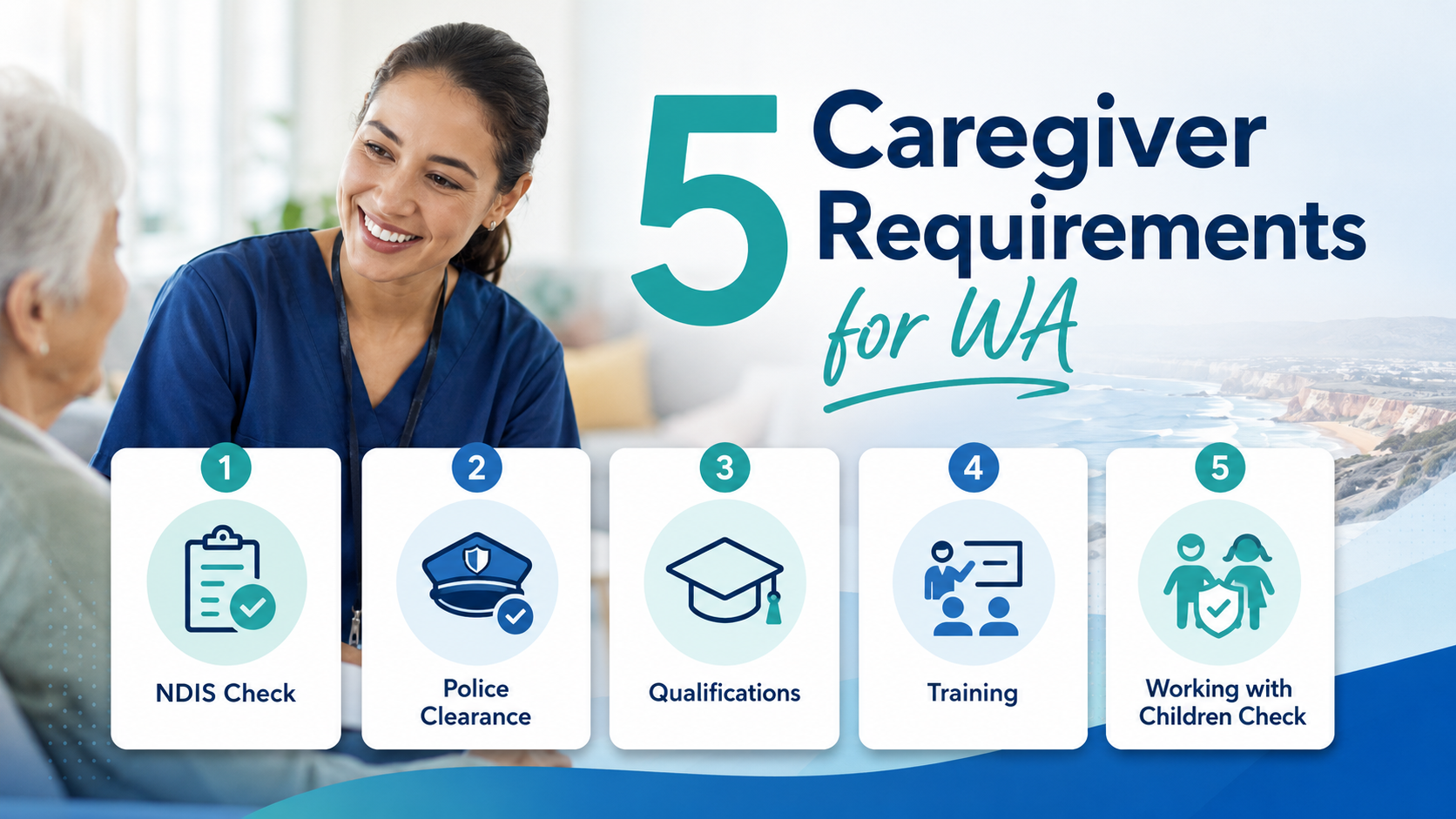
Thinking about relocating to WA to pursue a caregiving career? Here’s exactly what you need to have in order before you start applying.
Western Australia is experiencing strong and sustained demand for qualified caregivers. From aged care facilities in the Perth metro area to NDIS-registered providers across regional WA, the opportunities are real — but so are the compliance requirements. Before you pack your bags, make sure you have these five things sorted.
| Requirement | Needed for |
|---|---|
| NDIS Worker Screening Check | Risk-assessed disability/NDIS roles |
| National Police Certificate | Often requested by aged care, hospitals, agencies, and employers |
| Certificate III / Diploma / AHPRA registration or professional association requirements | Role-dependent |
| First Aid, CPR, Manual Handling | Common baseline onboarding requirements |
| WA WWC Check | Child-related caregiving, paediatric, school, or family-support roles |
1. NDIS Worker Screening Check
If you plan to work with people living with disability in WA, an NDIS Worker Screening Check is non-negotiable for any risk-assessed role. This is a national check managed in WA by the Department of Communities through the WA NDIS Worker Screening Unit, and it’s separate from a standard police clearance.
A risk-assessed role includes direct contact with NDIS participants — which covers most caregiving, support worker, and personal care positions at registered NDIS providers.
What you need to know:
- Start your application through the WA NDIS Worker Screening Unit before your first shift. Your employer may need to verify your application before it becomes valid, so ask them what details they need from you
- Current application fees are $145 for paid employees, $80 for eligible concession card holders, and $11 for volunteers or unpaid workers — always confirm the latest fee before applying
- The clearance is valid for five years and is portable across risk-assessed NDIS roles and providers across Australia
- It assesses criminal history, employment records, and other relevant information — not just a background check
If you’re already working in disability support interstate and hold an active clearance, it transfers to WA automatically.
2. National Police Clearance
For aged care roles, current screening rules generally require either a National Police Certificate not older than three years or a valid NDIS Worker Screening Check — not necessarily both. If you already hold an active NDIS Worker Screening Check, you don’t need a separate police certificate to satisfy aged care screening requirements under current Australian Government guidance.
That said, many employers — particularly hospitals, agencies, and residential care facilities — still request a recent National Police Certificate as part of their own internal onboarding process, regardless of what the law requires. It’s worth having one ready.
Key points:
- Apply through the Australian Criminal Intelligence Commission (ACIC) or an accredited provider
- Aim for a certificate dated within the last 12 months to satisfy most employer preferences
- Processing time is usually 1–5 business days, but allow more time if your history spans multiple states or countries
- Confirm with each employer whether they require this on top of an NDIS Screening Check
Getting a police clearance sorted early removes a common bottleneck in the hiring process.
3. Relevant Qualifications or Professional Registration
Many WA employers prefer or require formal qualifications for support worker, personal care, aged care, disability, and nursing roles. The exact requirement depends on the role, setting, client risk profile, and employer — but knowing the standard thresholds gives you a strong starting point.
Support Workers & Personal Care Assistants:
The standard entry-level qualification is a Certificate III in Individual Support (CHC33021), which covers aged care, disability, and home and community care pathways. Some employers — particularly in aged care — prefer or require a Certificate IV for more complex or supervisory roles.
Enrolled Nurses:
A Diploma of Nursing from a TAFE or RTO, plus current AHPRA registration, is required. Ensure your registration is active and not lapsed before applying.
Registered Nurses & Regulated Allied Health Professionals:
Registered nurses must hold current AHPRA registration. Some allied health professions — including physiotherapy, occupational therapy, psychology, pharmacy, podiatry, and medical radiation practice — also require AHPRA registration. Other allied health roles (such as speech pathology, dietetics, social work, and audiology) may be self-regulated through a professional association rather than AHPRA, so check the requirement for your specific discipline before applying. If you trained overseas, confirm whether your qualifications are recognised by the relevant body before relocating — this process can take several months.
If your qualifications are from interstate or overseas, contact the relevant body early — don’t assume automatic recognition.
4. Mandatory Training Certificates
Beyond your core qualification, WA employers expect you to arrive with a set of current training certificates that are considered baseline for the industry:
| Certificate | Renewal Frequency |
|---|---|
| First Aid — HLTAID011 Provide First Aid | Every 3 years |
| CPR — HLTAID009 | Annually |
| Manual Handling / Safe Moving & Handling | As directed by employer (often annually) |
| Infection Control | Typically at induction; refreshed annually |
| Dementia Awareness (aged care roles) | Often required or strongly preferred; providers must ensure workers receive competency-based training in caring for people living with dementia |
| Food Handling Safety (residential facilities) | Certificate level, required for kitchen/meal prep involvement |
Many short-course RTOs in WA offer these certificates, but you can also complete them interstate or through an online provider (for theory components) before you arrive. Arriving with current certificates demonstrates professionalism and means you can start sooner.
5. Working with Children (WWC) Check
If your caregiving role involves any contact with minors — paediatric support, family services, NDIS for children, or school support settings — you must hold a current Working with Children (WWC) Check issued by the WA Department of Communities.
Important: The WA card is state-specific. Even if you hold a Blue Card (Queensland), a Working with Children Check (Victoria), or equivalent from another state, you must apply for a WA card separately before you begin working.
What you need to know:
- Application is via the WA Department of Communities website
- Current fees are $87 for paid employees and self-employed people, and $11 for volunteers, unpaid workers, students on unpaid placement, or replacement cards
- Processing typically takes 2–6 weeks — apply well in advance of your intended start date
- The card is valid for three years and must be renewed before expiry if you continue child-related work
If you’re unsure whether your specific role requires a WWC Check, ask the employer directly. Responsible providers will always know.
Ready to Start Your Job Search in WA?
Getting your compliance documents sorted before you arrive puts you in the best possible position when an opportunity comes up. Many of our placements move quickly — and candidates who are compliance-ready get offered roles faster.
At NHR Staffing Group, we work with hospitals, aged care providers, NDIS organisations, and home care agencies across Perth and Western Australia. We’ll guide you through what’s needed for your specific role and connect you with the right employer.
Browse current healthcare and caregiving roles in WA — or if you’d like to speak with a recruiter about your move and what roles suit your background, get in touch with our team today.