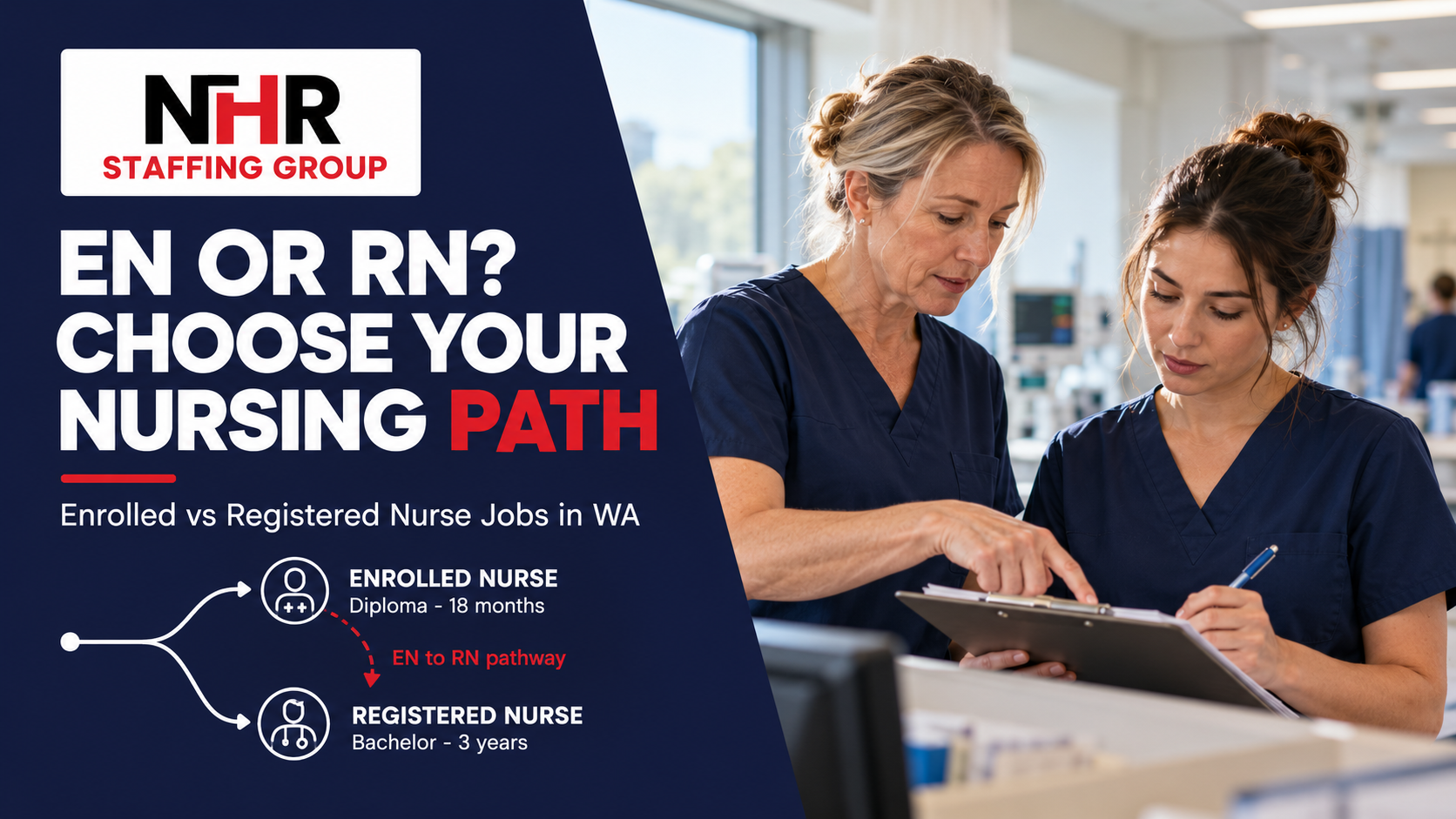
Short answer: should I look for enrolled nurse or registered nurse jobs in WA?
Enrolled nurses (ENs) qualify through an 18-month Diploma of Nursing and work under the supervision of a registered nurse (RN). RNs qualify through a three-year Bachelor of Nursing, practise with greater autonomy and are accountable for supervising ENs and delegating care to them. In WA Health, enrolled nurses on Levels 1-4 earn $1,526.76-$1,606.11 a week and RN Level 1 runs from $85,848 to $112,644 a year (rates in force from October 2026, checked 14 October 2026). ENs can later study to become RNs, and several WA universities offer credit for the diploma.
Both roles are registered nursing professions in Australia, each with its own NMBA standards, and in WA Health each has its own pay agreement and progression path. The real question is which one fits where you are now: how much time you can give to study, how much clinical responsibility you want, and where you want your career to go. This guide sets out the facts as they stand on 15 October 2026 so you can compare the two properly.
Four Things to Compare
| Enrolled nurse (EN) | Registered nurse (RN) | |
|---|---|---|
| Time to qualify | Diploma of Nursing, minimum 18 months | Bachelor of Nursing, three years full time (or a two-year graduate-entry Master’s) |
| How you practise | Under the direct or indirect supervision of an RN | With greater autonomy; accountable for supervising and delegating to ENs |
| WA Health starting rate, October 2026 | EN Level 1: $1,526.76 a week | RN Level 1.1: $85,848 a year (about $1,650.92 a week, our calculation) |
| Where you can progress | Advanced skill enrolled nurse (ASEN) levels, or an RN degree with credit for your diploma | RN Level 2 and senior registered nurse classifications |
These are base rates. Penalty rates, allowances, casual loading and superannuation are paid on top where they apply, and part-time pay is pro rata. The sections below explain each row, then help you weigh them up.
What Is the Difference Between an Enrolled Nurse and a Registered Nurse?
The main difference is supervision and accountability. The Nursing and Midwifery Board of Australia (NMBA) says an EN’s core practice “generally requires the EN to work under the direct or indirect supervision of the RN”, and that the EN “retains responsibility for his/her actions”. An EN must have a named and accessible RN available for support and guidance at all times.
RNs practise with greater autonomy, within their own competence and their employer’s policies. Under the NMBA’s standards for practice, RNs are “responsible and accountable for supervision and the delegation of nursing activity to enrolled nurses”. In day-to-day terms, the RN plans and coordinates care, and delegates parts of it to ENs who are competent to carry it out.
| Enrolled nurse (EN) | Registered nurse (RN) | |
|---|---|---|
| Qualification | Diploma of Nursing (AQF 5), minimum 18 months | Bachelor of Nursing (AQF 7), three years full time, or a two-year graduate-entry Master’s (AQF 9) |
| Clinical placement | Minimum 400 hours | Set by the approved degree |
| How they practise | Under direct or indirect supervision of an RN | With greater autonomy; supervises and delegates to ENs |
| Accountability | Accountable for their own actions and for delegated care within their competence | Accountable for their own practice and for decisions to delegate |
| Professional standards | NMBA Enrolled nurse standards for practice | NMBA Registered nurse standards for practice |
ENs are not “junior RNs”. It is a distinct registration with its own standards, and you can build a career in the role. WA Health’s enrolled nurse agreement includes advanced skill enrolled nurse (ASEN) classifications for experienced ENs who demonstrate additional competencies.
What Registration Do You Need for Each Role?
Whichever role you choose, you must be registered with the NMBA through Ahpra before you can work. The current Diploma of Nursing is HLT54121, which is listed as current on training.gov.au (Release 6, December 2025). For RN registration, you need an NMBA-approved Bachelor of Nursing or graduate-entry Master’s.
Once you are registered, the same core registration standards apply to you whether you are an EN or an RN:
- Continuing professional development: a minimum of 20 hours each registration year, for ENs and RNs alike.
- Recency of practice: practice equivalent to at least 450 hours within the past five years.
- English language skills, criminal history and professional indemnity insurance: separate NMBA registration standards apply to both roles.
A note on medicines for ENs. As an EN, you can administer medicines unless your registration carries the notation “Does not hold Board-approved qualification in administration of medicines”. To remove it, you complete the medicines unit (HLTENN040, previously HLTENN007) in an NMBA-approved Diploma of Nursing and apply to the Board. Without the notation, you can only give intravenous medicines if you have completed IV education. WA Health’s summary of the state’s Medicines and Poisons legislation lists enrolled nurses among the professionals authorised to administer scheduled medicines, provided they do not hold that notation, and within the scope their employer allows.
If you hold the notation, check whether it limits the roles you are applying for, and consider removing it before you apply.
What Do Enrolled Nurses and Registered Nurses Earn in WA?
Pay depends on whether the employer is in the public or private sector, and on your classification and experience. The figures below come from the industrial agreements and award themselves. They are base classification rates, not a promise of what any individual offer will be, and they exclude penalties, allowances, casual loading and superannuation.
WA Health (public sector)
If you are an enrolled nurse, WA Health pays you under its 2024 enrolled nurses agreement with the United Workers Union (WA), which sets weekly rates. From 7 October 2026:
| EN classification | Weekly rate from 7 October 2026 |
|---|---|
| EN Level 1 (first year as an EN) | $1,526.76 |
| EN Level 2 | $1,553.21 |
| EN Level 3 | $1,579.65 |
| EN Level 4 | $1,606.11 |
| ASEN 1 | $1,659.01 |
| ASEN 2 | $1,711.90 |
| ASEN 3 | $1,764.83 |
Multiplied by 52 (our calculation, not a figure from the agreement), EN Levels 1-4 equal roughly $79,400-$83,500 a year, and ASEN 3 roughly $91,800.
If you are a registered nurse, WA Health pays you under its 2024 registered nurses and midwives agreement with the Australian Nursing Federation (ANF), which sets annual rates. From 12 October 2026:
| RN classification | Annual rate from 12 October 2026 |
|---|---|
| RN Level 1.1 (entry) | $85,848 |
| RN Level 1.4 | $96,510 |
| RN Level 1.8 (top of Level 1) | $112,644 |
| RN Level 2.1-2.4 | $115,717-$124,087 |
RNs move up through the Level 1 increments annually, based on experience. Under the agreement, nurses who work an average of 24 hours a week or less need a further 12 months before moving to the next increment.
Both agreements run to October 2027, and both have already applied their October 2026 increases. If you are comparing salary figures online, check the date: older pages may still quote 2025 rates.
Private hospitals and aged care
Outside WA Health, your pay is usually set by the Nurses Award 2020 or by an enterprise agreement, which is assessed against the award when it is approved. The award’s minimum full-time weekly rates for employees outside aged care, from the first full pay period on or after 1 July 2026, are:
- Enrolled nurse: $1,139.90 (pay point 1) to $1,199.20 (pay point 5)
- Registered nurse level 1: $1,219.50 (pay point 1) to $1,465.50 (pay point 8 and thereafter)
Aged care employees have their own classifications and rates in the award. For example, a first-year registered nurse level 1 in aged care has a minimum of $1,571.60 a week, from the first full pay period on or after 1 August 2026. These are minimums; employers can pay above them.
Where Are EN and RN Jobs in WA?
Both roles are employed across the same broad settings, but the mix of responsibilities differs.
- Public hospitals and health services. WA Health employs both ENs and RNs under the agreements above, across metropolitan health services and the WA Country Health Service.
- Private hospitals. Usually under an enterprise agreement or the Nurses Award.
- Aged care. Both roles are covered by the award’s aged care classifications. As in any setting, ENs in aged care work under the supervision of an RN or nurse practitioner. Our guide to aged care jobs in Perth covers the qualifications each role needs.
- Regional and remote WA. Country health services and private providers recruit both roles. If you are open to moving, see our guide to regional healthcare work in WA.
Graduate programs. If you are newly qualified as an EN, RN or midwife in WA, you can apply through GradConnect, a single application process coordinated by WA Health that covers public, private and aged care providers. There is one round each year. The 2026 round closed on 18 March 2026, for positions starting between July 2026 and June 2027. WA Health says the next round, 2027 GradConnect, will cover positions starting between July 2027 and June 2028; check the WA Health GradConnect page for the application dates. In 2024-25, 82% of GradConnect recruits were offered metropolitan public health roles and 18% regional or remote roles.
GradConnect is one route, not the only one. The NMBA notes that graduates “commonly complete a supported transition to practice program, though this is not mandatory”, so if you miss a round you can still apply directly to employers when they advertise graduate or new-to-practice roles.
For a wider view of the WA nursing market, read our guide to nursing jobs in Perth and WA.
How Do You Move From Enrolled Nurse to Registered Nurse in WA?
If you are an EN, several WA universities give credit for your Diploma of Nursing towards a Bachelor of Nursing, so you do not have to start from scratch:
- Murdoch University. Murdoch’s Bachelor of Nursing study plans for enrolled nurses show 24 of 72 credit points granted as advanced standing, with the full-time sample plan running over two years. Murdoch asks ENs to supply their Ahpra registration certificate when applying.
- Curtin University. Curtin offers an Enrolled Nurse to Registered Nurse stream within its Bachelor of Science (Advanced Nursing), at Curtin Perth, Curtin Kalgoorlie and the Southern Regional TAFE campus in Albany. In an October 2026 media release, Curtin said recent course changes let domestic students complete the degree in 18 months at Curtin Kalgoorlie.
- The University of Notre Dame Australia. Notre Dame says diploma graduates have the opportunity to apply for one year of credit towards its Bachelor of Nursing.
Credit, duration and entry rules change from year to year and depend on when and where you qualified, so confirm the details with the university before you enrol. If you keep working as an EN while you study, those hours count towards recency of practice, but you still need to renew your registration each year and meet the CPD and other registration standards.
Which Path Is Right for You?
The trade-off is shorter study and supervised practice as an EN, against longer study, broader accountability and a higher pay ceiling as an RN.
Enrolled nursing may suit you if you can commit to a diploma of at least 18 months but not yet to a three-year degree, you prefer hands-on care within a team led by an RN, and you want the option to progress to ASEN classifications in WA Health or move on to an RN degree later with credit for your diploma.
Registered nursing may suit you if you want to plan and lead care, supervise and delegate to others, and move towards RN Level 2 and senior classifications. It takes longer to qualify, and in WA Health the entry rate is higher (about $1,650.92 a week at RN Level 1.1, against $1,526.76 at EN Level 1).
If you are already an EN, the decision is mostly about timing. Check your medicines notation, look at how much credit your diploma earns at each university, and decide whether you can study while you work.
What to Do Next
- Check your registration. Search the Ahpra register for your name and confirm your registration type and any notations.
- Compare the pay tables. Work out where you would sit on the WA Health tables above, or ask a prospective employer which agreement or award applies.
- If you are a new graduate, watch the WA Health GradConnect page for the 2027 round dates.
- If you are an EN thinking about the RN degree, contact Murdoch, Curtin or Notre Dame about credit for your diploma.
- Register with NHR Staffing Group (NHR). Registration is free, and an NHR consultant can help you compare roles by setting, location and shift preferences, and check how your registration and any notations fit. Start on our careers page or apply now.
Frequently Asked Questions
Can an enrolled nurse work without a registered nurse in WA?
No. The NMBA says ENs work under the direct or indirect supervision of an RN, and an EN must have a named and accessible RN available for support at all times. Under indirect supervision, the RN works in the same facility or organisation but does not observe the EN constantly, and must be available for reasonable access.
How long does it take to become an enrolled nurse?
The Diploma of Nursing (HLT54121) takes a minimum of 18 months, including at least 400 hours of clinical placement. You then apply to the NMBA through Ahpra for registration as an enrolled nurse.
How much does an enrolled nurse earn in WA Health?
From 7 October 2026, WA Health’s EN Levels 1-4 are paid $1,526.76-$1,606.11 a week, and advanced skill enrolled nurses up to $1,764.83 a week. These are classification rates under the WA Health enrolled nurse agreement.
How much does a registered nurse earn in WA Health?
From 12 October 2026, RN Level 1 in WA Health is paid $85,848 at entry, rising to $112,644 at the top increment. RN Level 2 runs from $115,717 to $124,087.
Can enrolled nurses give medications in WA?
Yes, unless their registration carries the NMBA notation “Does not hold Board-approved qualification in administration of medicines”. Intravenous medicines also require IV education, and employers can set their own limits within the law.
How long does it take an EN to become an RN in WA?
It depends on the university and your diploma. Murdoch’s sample full-time plan for ENs runs over two years with 24 of 72 credit points granted, and Curtin says its EN to RN pathway can be completed in 18 months at Curtin Kalgoorlie.
Can new graduate ENs apply through GradConnect?
Yes. WA Health’s GradConnect process is open to newly qualified enrolled nurses, registered nurses and midwives, with one round each year, but it is not the only route; you can also apply directly to employers. The 2027 round covers positions starting from July 2027.